Christopher Nolan’s Epic Reinvents a Timeless Classic
Rating: ★★★★★★★★★☆ (9/10)
Mumbai: Christopher Nolan’s The Odyssey (2026) stands as one of the most ambitious cinematic achievements of recent years, transforming Homer’s immortal epic into a visually spectacular and emotionally resonant modern masterpiece. Written, directed and produced by Nolan alongside Emma Thomas, the film delivers nearly three hours of breathtaking storytelling that rewards audiences with an unforgettable theatrical experience.

Shot entirely on IMAX film, The Odyssey is grand in every sense. Nolan approaches Odysseus’s decade-long struggle to return to Ithaca after the Trojan War with his trademark fascination for time, memory, guilt and the fragile boundary between destiny and human choice. Rather than presenting the gods as traditional supernatural beings, he interprets them as overwhelming forces of nature, lending the ancient tale a grounded yet mystical realism.
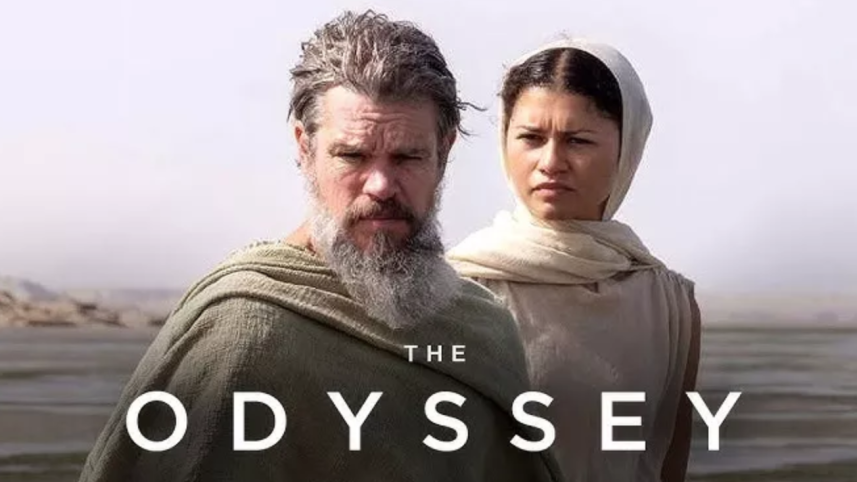
Matt Damon delivers one of the finest performances of his career as Odysseus. His portrayal captures the legendary hero’s brilliance, weariness and emotional scars, making every triumph and setback deeply personal. Anne Hathaway is equally compelling as Penelope, portraying unwavering strength, intelligence and quiet resilience while defending her kingdom from relentless suitors. Tom Holland impresses as Telemachus, bringing maturity and emotional depth to a young man searching for both his father and his own identity.
The supporting ensemble is exceptional. Zendaya brings wisdom and mystery to Athena, while Charlize Theron, Lupita Nyong’o, Robert Pattinson and the rest of the cast enrich every chapter of the journey. Even the more unconventional casting choices contribute fresh perspectives to this timeless narrative.
Technically, the film is extraordinary. Hoyte van Hoytema’s breathtaking cinematography transforms every frame into a work of art, while Ludwig Göransson’s stirring score amplifies both the grandeur and intimacy of the story. Nolan’s commitment to practical effects and large-scale location shooting gives the Cyclops’ cave, the Sirens, the Trojan War flashbacks and the descent into Hades remarkable authenticity and scale.

Beyond its spectacle, The Odyssey succeeds because of its emotional core. It explores the cost of war, the burden of leadership, the meaning of loyalty and the universal longing for home with surprising tenderness. The parallel narratives of Odysseus’s voyage and Penelope’s struggle in Ithaca create an emotionally satisfying balance between adventure and family drama.
The film’s only significant drawback is its length. At nearly three hours, portions of the middle act occasionally slow under dense exposition and Nolan’s characteristic non-linear storytelling, which may challenge some viewers. A few bold interpretive choices, including Travis Scott’s bard character, may divide audiences, but they rarely detract from the overall experience.
Ultimately, The Odyssey is Christopher Nolan at the height of his creative powers. It is a visually stunning, intellectually rewarding and emotionally powerful adaptation that honours Homer’s masterpiece while making it feel remarkably contemporary. This is event cinema at its finest—a film best experienced on the biggest IMAX screen available.
Verdict: Christopher Nolan delivers a monumental epic that combines myth, emotion and cinematic innovation into one of the defining blockbusters of the decade.
Rating: 9/10


 ---------------------------------------------------------------------------------------------------